

CUSTOMERS
Neste invests in competency management and training at its Rotterdam refinery – eLearning materials produced by Qreform
CUSTOMERS
Neste invests in competency management and training at its Rotterdam refinery – eLearning materials produced by Qreform
Images: ©Neste
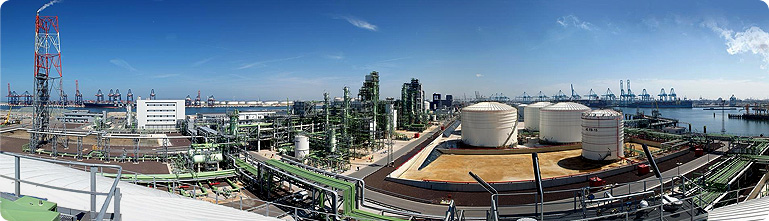
The world’s leading producer of sustainable aviation fuel (SAF) and renewable diesel, Neste, launched a capacity growth development project in 2022 to increase its renewable products production. The Rotterdam Capacity Growth project, RDCG for short, is expanding Neste’s production capacity while also promoting cleaner energy solutions, and reduced carbon footprints. The overall investment amounts to approximately 2.5 billion euros.
One of the most critical priorities in the project has been to ensure staff competency at all stages of the process. Since late 2023, Neste has partnered with Qreform on its eLearning material production for the RDCG Project. Competence Development Manager Djini Bhugwansing and Competence Developer Nour Nassar have found the partnership to be well-structured, flexible and, most importantly, able to produce high-quality end products.
Competent employees ensure safety and efficiency
Since 2022, Neste has expanded its refinery in Rotterdam, the Netherlands, to increase its capacity for SAF (Sustainable Aviation Fuel) production. SAF production began in Rotterdam in April 2025, and the refinery is now able to produce up to 500,000 tons of SAF per annum. On a global scale, this increased Neste’s annual SAF production capability to 1.5 million tons.
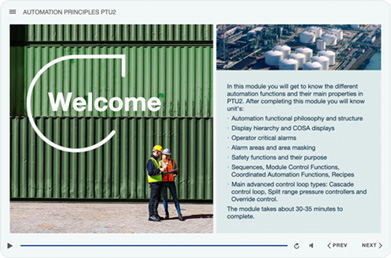
As to ensuring safe and timely operation in Rotterdam, competency management has been one of the key elements.
“Effective competency management is the backbone of any safe company’s operations. It helps to control risks and to ensure safe and efficient operation,” Bhugwansing says.
In a massive project such as RDCG, education and training also need to be carefully targeted; not everyone can be taught everything.
“Competency management has been very important to us, as we need to make sure that we have the right people and skills to handle everything we need – to match the tasks and the talent. Structured competency management helps us to ensure that our training is aligned with the requirements and the big picture, and that safety is ensured throughout,” Nassar adds.
Large-scale eLearning project with variable schedules
In late 2023, Neste partnered up with Qreform on its eLearning material production for the RDCG Project. The companies had already had a long joint history in other cooperation, from 2014 onwards. For example, Neste uses the L2O platform for its competency and shift management. The platform is hosted by Qreform, and it is based on Qreform’s Rego software.
For Neste’s RDCG Project, Qreform will produce a total of over 40 eLearning modules. The topics cover four main areas: pre-commissioning, commissioning, automation and special equipment training modules.
All the individual 40+ topics vary in content, and they all involve input provision by different sets of specialists. The target audience consists of many roles and nationalities, yet the eLearning materials must produce a uniform level of knowledge.
Both Bhugwansing and Nassar find that open communication and cooperation with Qreform have been key in coping with the challenging framework and circumstances.
“Our timetables are not set in stone, so things change every day and sometimes even hourly. We have all had to adapt, and this has also required flexibility from Qreform. So far, we’ve managed to keep everything well on track,” Nassar says.
“That’s right, the process has involved a learning curve for us all. In addition to changes in timing, the materials involve lots of reviews. One of the reasons for choosing Qreform as our partner was that they understand all of this. They have been very flexible, which makes it easier for us to go cooperate with them,” Bhugwansing says.
Well-structured and flexible cooperation, high-quality end results
In a working environment such as Neste’s refinery in Rotterdam, training materials need to be of high quality and consistent, but also time efficient. Both content production and course completion must be resource efficient to optimise specialists’ valuable time management.
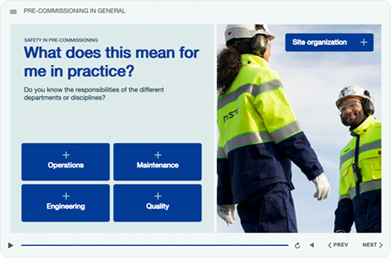 “With good project and time management, we have shortened the working time for the development of the e-learnings, and we have effectively used the time of the specialists.” Bhugwansing says.
Qreform’s Account Manager Annika Rintamäki has led the project from the service provider’s side and managed day-to-day operations with a dedicated team. With over 40 study modules to produce, multiple topics need to be advanced simultaneously. Rintamäki commends Neste’s efforts to achieve genuine competency and ensure safety throughout.
“Training can be provided in many ways and forms. I appreciate Neste’s decision to invest in high-quality training materials which are refined from a massive amount of source material. This way, we are relieving employees’ study burden and making their learning significantly more efficient. The end results are notably better this way – compared to relying on everyone’s independent reading,” Rintamäki notes.
As for Neste, both Bhugwansing and Nassar find the partnership with Qreform open and fluent. Feedback from users has also been largely positive. In particular, in-built interaction in the materials has been well received and found useful.
“Collaboration with Qreform has gone well. It took some time first to find a structured way to cooperate, of course, but soon everything clicked and we found the right rhythm. It has been a great partnership, and we have also learned a lot together,” Nassar says.
Bhugwansing agrees.
“We have found a very structured way to make eLearning materials together. The quality of the end products is also high, which is very important to us, of course,” Bhugwansing concludes.
Customer stories

Rego HSEQ
Comprehensive software solution for occupational safety, quality, risk and competence management.